
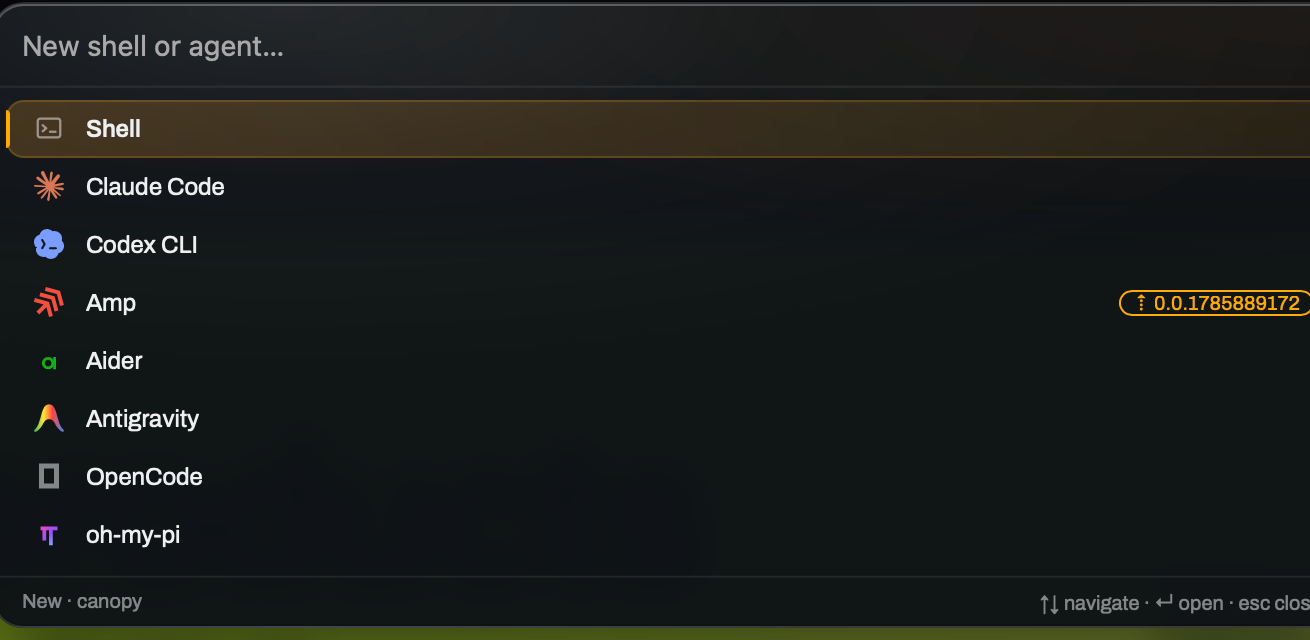
Canopy launches real coding CLIs in terminals, including Claude Code, Codex, Amp, Aider, Antigravity, OpenCode and oh-my-pi. They don't all expose the same hooks, session history, usage data or file attribution. Use the table to choose a workflow, then test your CLI in your installed build.
Read the table as an audit snapshot
The table summarizes Canopy's integration audit of the main branch, August 2026. It doesn't certify a release, every CLI version or model quality. ‘Resume’ means Canopy has a resume command; success depends on the CLI's session store. ‘Events’ means lifecycle signals, not every prompt and tool call. File attribution means assigning paths to one agent in a shared checkout.
| CLI | Resume | Session events | Shared-checkout file attribution | Receives shared context |
|---|---|---|---|---|
| Claude Code | Yes | Yes | Full | Yes |
| Codex CLI | Yes | Yes | Full | Yes |
| Amp | Yes | Yes | No | No |
| Aider | No per-session resume | Limited | No | No |
| Antigravity CLI | Yes | Yes | Tool dependent | No |
| OpenCode | Yes | Yes | Built-in edit/write | No |
| oh-my-pi | Yes | Yes | No | No |
Start with the provider and task you already have
Sign in to the CLI you already use. Its provider controls models, limits and billing; Canopy has no subscription that unlocks every model. For a first trial, use the repository and task you'd use in a plain terminal.
Plan for resume and shared context
For multi-day work, confirm the CLI saves a recoverable session and Canopy offers resume for it. Aider keeps a directory-level chat file, not per-session resume. Of the seven, only Claude Code and Codex receive Canopy's shared context; the others work fine as terminals. A short branch-and-task handoff helps with every CLI.
Don't overread an agent's file list
In separate worktrees, a checkout's changes belong to its agent. In a shared checkout, attribution needs tool events with file paths. The audit rates Claude Code and Codex full, OpenCode's built-in edit and write tools attributable, Antigravity tool dependent, and others unverified or unavailable. Always review the whole Git diff; a missing row doesn't mean nothing changed.
Check usage in the right place
The audit's usage row isn't a billing matrix: Claude Code has full token, cost and model data, several CLIs show only the model, others nothing. v0.3.4 added OpenCode tokens and cost to Statistics. A model name, an estimate, a plan-limit bar and an invoice answer different questions. Use the provider account for real charges.
Test your installed build in 10 minutes
In a throwaway repository, launch your CLI and ask for a tiny, reversible edit. See whether Canopy shows the right agent state and attributed file, then check Git Changes. Close and resume if the CLI supports it. If you'll use two CLIs, repeat with the second in its own worktree and pass a short handoff.
Read release notes and the audit together
The audit tracks the main branch and can differ from any release; the latest release is v0.4.8. v0.3.4's notes, for example, include an OpenCode attribution fix. For a claim about a specific install, read its release notes, check the UI and record the Canopy, CLI and platform versions.
Copyable resources
Run the same small task for every CLI you're considering.
Canopy version/platform: [ ]
CLI/version/account: [ ]
Repository/branch and task: [ ]
Launched in a real terminal: [yes/no]
Session state and permission signals seen: [ ]
Changed file shown in agent view: [ ]
Git diff confirms the edit: [ ]
Resume action offered and tested: [ ]
Usage shown, with time and source: [ ]
One limitation or workaround: [ ]
Frequently asked questions
Does Canopy give me Claude, Codex, and OpenCode models under one account?
No. Canopy runs installed CLIs. Each uses its own provider account, models, limits and billing.
Can I resume every CLI session from the launcher?
No. The August 2026 audit lists a resume command for most CLIs but not Aider. Test your build and CLI version before relying on it.
Why can Git show a change when the agent file list is empty?
Git sees every working-tree change, whichever process made it. Per-agent attribution in a shared checkout needs path-bearing events from the CLI, and Canopy won't guess and assign edits to the wrong agent.