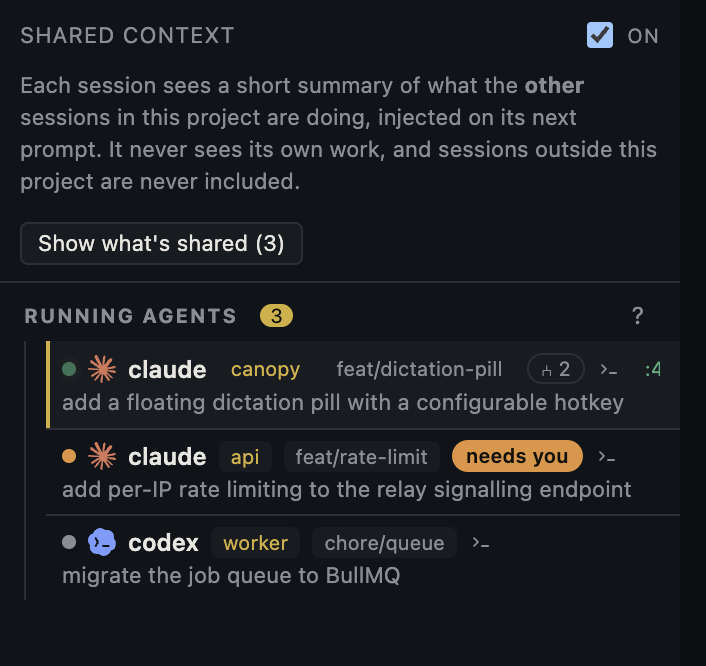
The screenshot of six agents working at once is easy to share. The harder screenshot is the clean PR that followed. Parallel work only helps when each agent has a bounded outcome and someone owns the integration.
Count independent jobs, not open tabs
Two agents can work well in parallel if one changes an API and the other researches an unrelated migration. They can also trip over each other if both are changing the same component's contract. Before launching another session, write down its output and the files or behavior it may affect. If that boundary is unclear, a second agent is probably premature.
Give each code change a checkout
An isolated Git worktree gives an implementation its own branch and working files. That does not magically solve conflicting designs, but it prevents one agent's edits from silently replacing another's. Canopy connects each agent workspace to its branch, files, commits, and PR so you can see the unit of work instead of reconstructing it from terminal scrollback.
Let agents coordinate, then verify the agreement
Shared project context and direct agent messages can reduce the copying between sessions. They are useful for telling a reviewer what an implementer changed or flagging an overlapping file claim. They do not replace an explicit decision about the API, acceptance criteria, or final owner. Read the changed code and the running result yourself.
Review is part of the job
A good division might be: one agent investigates, one implements, and another reviews the PR. The reviewer should test the claims and find risks, not congratulate the implementer. Canopy's review workflow stages findings for a person to vet before anything is posted. Follow-up tasks can address comments or failing CI, but inspect the new diff after each round.
Measure what merged
More completed turns are not the goal. Look at accepted changes, rework, elapsed time, and the decisions that waited on a person. Usage estimates can help compare approaches, but do not treat them as an invoice or a quality score. If an extra agent adds handoff time and conflict resolution without improving the result, reduce the swarm.
Frequently asked questions
Do more agents always make a project faster?
No. Parallel work helps when tasks are independent; overlapping edits and unclear ownership can add coordination and rework.
What should one agent own?
Give it a bounded outcome, a checkout or branch, and a reviewable result. Keep one person responsible for integrating the work.